Converge — declarative resource orchestration

Introduction • Quickstart • Demos • Docs • API reference • Contributing


Introduction
A declarative orchestration engine for platform teams building internal developer platforms (IDPs), self-service infrastructure APIs, and control planes: you describe the resources you want as specs, and Converge reconciles the world to match — composing, ordering, healing, and rolling up status. It is built for scale (millions of resources, thousands of reconciliations per second), simplicity (a single binary + a database), and reactivity (work is pushed, not polled).
It is provider-agnostic — the core knows no concrete resource type. You teach it a kind by applying a Kubernetes CRD-style manifest plus handler code in a worker, and that handler can do anything: run Terraform, a shell script or any binary, a Kubernetes Job, or any cloud/API call.
Like Crossplane and kro, it composes a resource into a graph of children and rolls their readiness up into the composite's status — but dependency edges and value flows are first-class declarative data, not imperative controller code, so you write the composition in Go, TypeScript, CEL, Starlark, or any external program. The logic that makes decisions is real code, not a templating dialect — see why workers are code, not YAML (and how an AI agent can write one for you from the demos). See how Converge compares to Terraform/Pulumi, K8s operators, and Temporal/Restate.
Architecturally it is a single binary over Postgres — a control plane and a broker mesh that any-language workers dial to pull work (topology). New here? Start with Concepts for the whole mental model on one page; for the whole feature surface at a glance, see Converge at a glance.
Quickstart
One command stands up the whole thing — control plane + broker mesh + a worker + the web UI, against a throwaway Postgres — and runs a live demo. You only need just; just setup checks the rest of the toolchain (Go, Node, Docker):
git clone https://github.com/salesforce/converge.git && cd converge
just setup                                  # (optional) verify Go/just/Node/Docker are installed
just install                                # install the converge/stdworker/conctl binaries onto your PATH (GOPATH/bin)
cd examples/demos/classic && just demo      # builds everything, then spins the cluster + applies a demo
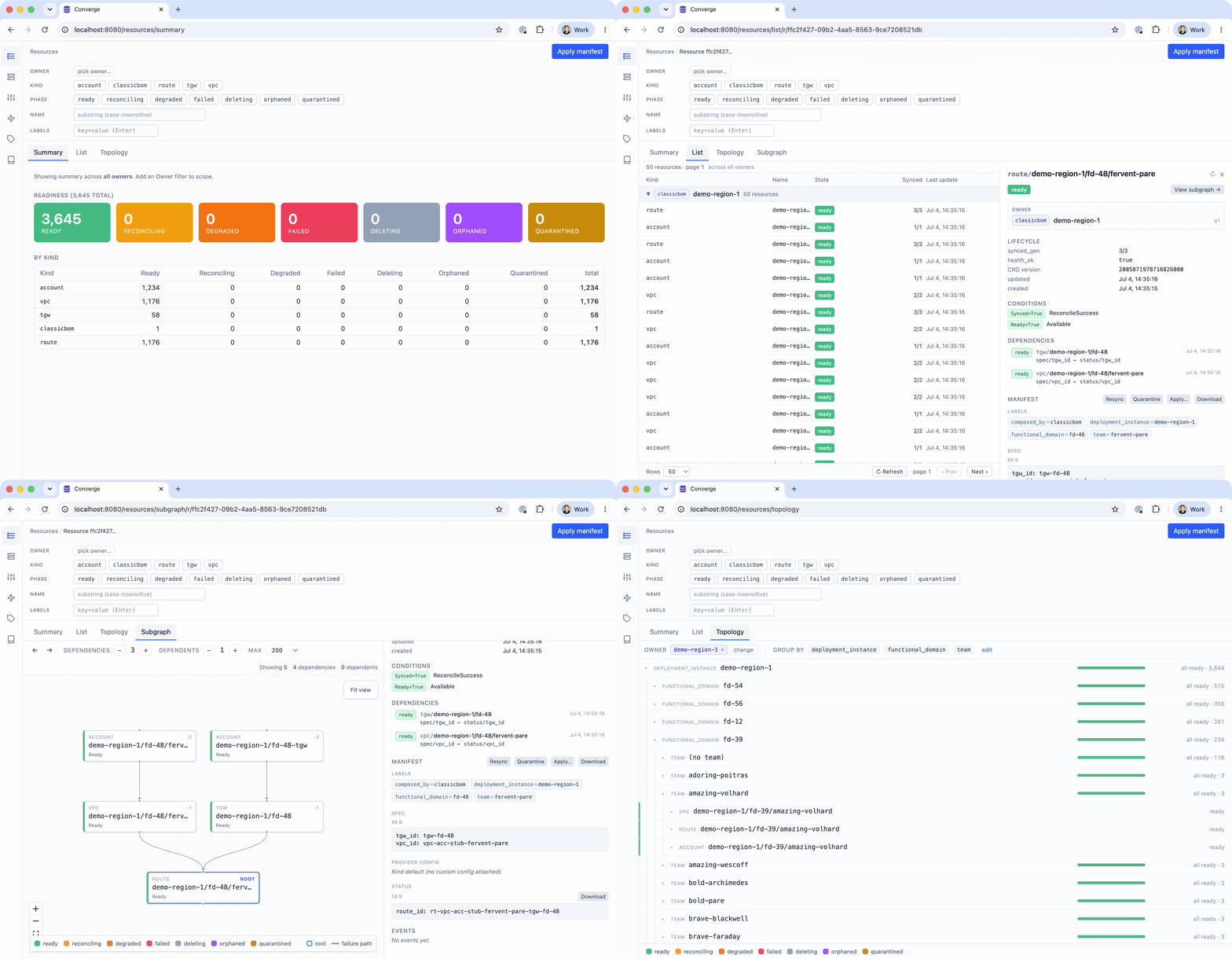
Then open the UI at http://localhost:8080 and watch a BOM fan out into accounts/VPCs/routes/TGW and converge to Ready. Ctrl+C tears it all down. Eight demos cover Go, CEL, Starlark, Terraform, any-language stdio, TypeScript, GitOps sync, and a Backstage golden path — see Demos below.
What it's great for
Example — a landing zone. One landingzone composer declares the shape once; a single
spec — { kind: landingzone, name: payments, spec: { accounts: 100, tier: pci } } — fans out
into 100 AWS accounts, each expanded in dependency order into the VPCs, routes, TGW,
guardrails, and IAM that different teams own. Converge flows each account's account_id into
its VPC, the vpc_id into its routes, and rolls it all up into one status — Ready only when
every child is healthy, else Degraded naming the culprit. Edit a kind and every landing zone
re-converges; no tickets, no central Terraform monolith.
More broadly, Converge fits when many dependent resources must be continuously reconciled, not provisioned once and forgotten:
- Self-service platform APIs — one high-level request expands into all the underlying cloud and API objects, so app teams declare what they want without learning the substrate.
- Ordered dependency graphs — resources come up in the right order, each one's outputs feeding the ones that depend on it, with no glue code to wire them.
- Fleet-wide drift correction — anything that drifts is detected and healed automatically, continuously, across millions of resources.
- Status you can trust — a composite is healthy only when everything under it is, and it tells you which piece is at fault when it isn't.
- Automatic follow-up actions — run a durable side effect whenever something changes (record a result, clean up, notify), without wiring a separate workflow.
Providers
A worker is just a client that dials the broker and pulls work, so it can be written in any
language. Converge ships two worker SDKs: sdk-go/converge for Go and
converge-worker-sdk for TypeScript.
You don't have to write a provider at all. Converge ships a default worker,
stdworker, hosting a set of generic built-in providers —
including stdio, which makes any external program (a bash script, a Python file, a binary
in any language) a resource kind, no SDK import or compile step.
A composer is just a provider too, so composition is equally pluggable — Go, declarative CEL rules, a kro-style CEL resource graph, or a Starlark program.
To implement your own, see docs/implementing-a-provider.md — defining a kind (provider handler code + CRD manifest), the input/output contract, value flows, status rollup, and terminal-vs-transient failure.
Demos
Eight runnable demos, each with a just demo and a walkthrough in its README (the Quickstart shows the flow):
- classic — a hand-written Go composer fans a BOM of teams into accounts/VPCs/routes.
- datadriven — the same DAG built as data, no Go: CEL rules, a kro-style CEL resource graph, and a Starlark program.
- stdterraform — a real
tofu apply(OpenTofu) on a module, outputs rolled into status, destroy on delete. - stdio — bridge any external program (any language, no Go) into a kind over the stdio protocol.
- stdshell — run a script carried inline in the resource spec.
- typescript — a composer + leaves written in TypeScript on the
converge-worker-sdkSDK. - gitops — reconcile a directory of manifests with
conctl sync, Argo-CD/Flux-style (apply + prune by app scope). - backstage — a Backstage golden-path template provisions a deployment through Converge; one
docker compose upbrings up the whole stack (Converge + a real Backstage UI, pre-wired).
Install & run
- Installation & running guide — running it for real against your own Postgres/RDS/Aurora, as images, or on Kubernetes/Helm.
- High availability & disaster recovery — surviving pod, database, and zone failures.
Binaries
Three shipped binaries (plus each demo's own worker):
converge— the server (control plane and/or broker tier).conctl— the kubectl-style CLI for the REST API.stdworker— the default worker, hosting the built-in std* providers.
Get them one of three ways:
- Install script — detects your OS/arch, downloads the matching release archive, verifies its checksum, and installs to your PATH:
curl -fsSL https://raw.githubusercontent.com/salesforce/converge/main/install.sh | sh
- Prebuilt archives — download a per-platform tarball (linux/darwin × amd64/arm64) from the latest release; each contains all three binaries, with a
SHA256SUMSto verify. - From source —
just build(intobin/) orjust install(onto your PATH).
Status
Converge is v0.x and experimental: until a stable v1.0.0, nothing is guaranteed backwards-compatible and anything (API, protos, CLI, schema) may break between releases.
Contributing & license
Contributions are welcome — see CONTRIBUTING.md for the build/test workflow, coding conventions, commit/branching model, and how to open a PR. Please also read the Code of Conduct. To report a vulnerability, see SECURITY.md.
Licensed under the Apache License 2.0.